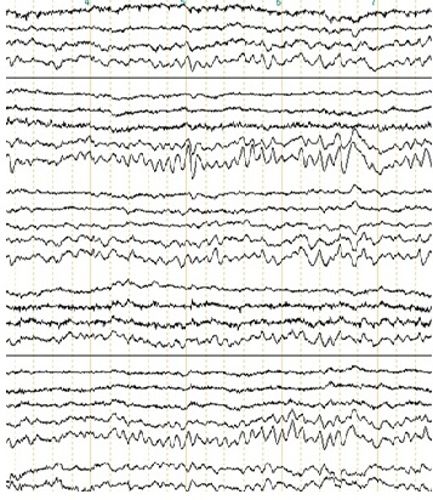
Technical Focus: Clean EEG Signals, Electrode Innovation & Advanced Analysis
Achieving reliable BCI starts with capturing clean, robust EEG signals. Our work centers on designing innovative scalp electrode arrays that maximize spatial resolution and comfort while minimizing artifacts. Once captured, these high-quality signals undergo advanced Fast Fourier Transform (FFT) analysis to extract meaningful brainwave features for real-time decoding. This two-step approach—superior signal detection followed by powerful spectral analysis—is foundational to both our creative and language-intention goals. We invite collaboration from engineers, neuroscientists, and hardware specialists to advance electrode design, artifact resistance, and open-source analysis pipelines.
- Innovative electrode arrays for cleaner, more comfortable EEG acquisition.
- Artifact-resistant detection for robust, real-world use.
- Advanced FFT and signal processing pipelines for extracting actionable brainwave features.
- Open-source hardware and spectral analysis tools for community-driven innovation.
We're honing our EEG recording parameters for exquisite precision, minimizing the "clutter" that clouds AI inputs—pristine data paves the way for truly captivating creations.
We hold that much of the diminished clarity in EEG recordings stems from rampant artifacts that obscure the subtlest neural whispers. Clinical amplifiers routinely discern waves as faint as 0.5 μV, while signals dipping to 1 μV often demand detection in forensic contexts to affirm electrocortical silence in cases of suspected brain death. This realm of ultra-fine resolution is no stranger to the field—merely a formidable craft to wield with unwavering consistency.
Moreover, our initial EEG captures will eschew the elaborate post-recording software sorcery now commonplace for scrubbing artifacts from raw traces. By deferring such interventions until signal purity peaks, we stand poised to elevate today’s pinnacles of resolution—even for scalp-derived models decoding language (as text) from brain rhythms.
Our Technical Tricks
The skin can be prepped using time-honored EEG essentials to achieve equilibrated impedances hovering just above 500 Ω, yet shy of 1 kΩ. These thresholds, seldom spotlighted in scholarly discourse, are eminently attainable as standard practice.
Electrode surfaces must steer clear of unalloyed metals, whose galvanic potentials sow discord in recordings—particularly at the languid low frequencies that echo our brain’s primordial cues for motion intent. Today, these signals elude steadfast capture, besieged by artifacts from undue polarization. The age-old chlorination of silver electrodes offers a bulwark, outshining mere metallic sheaths for stabilizing those deeper drifts. Enhanced waterproofing, too, will extend electrode endurance, while localized shielding against household electromagnetic hums will sharpen fidelity further.
Dense arrays in caps, though handy for easing technician toil in setup, falter when chasing rock-steady, low impedances—and they often court pressure-induced throbs. Paste-laden cup electrodes, by contrast, prove far gentler and steadfast for protracted sessions. We envision crafting a swifter-placement alternative with matching dependability; with secured funding, we’ll pioneer robotic deployment to upend the prep phase of EEG entirely.